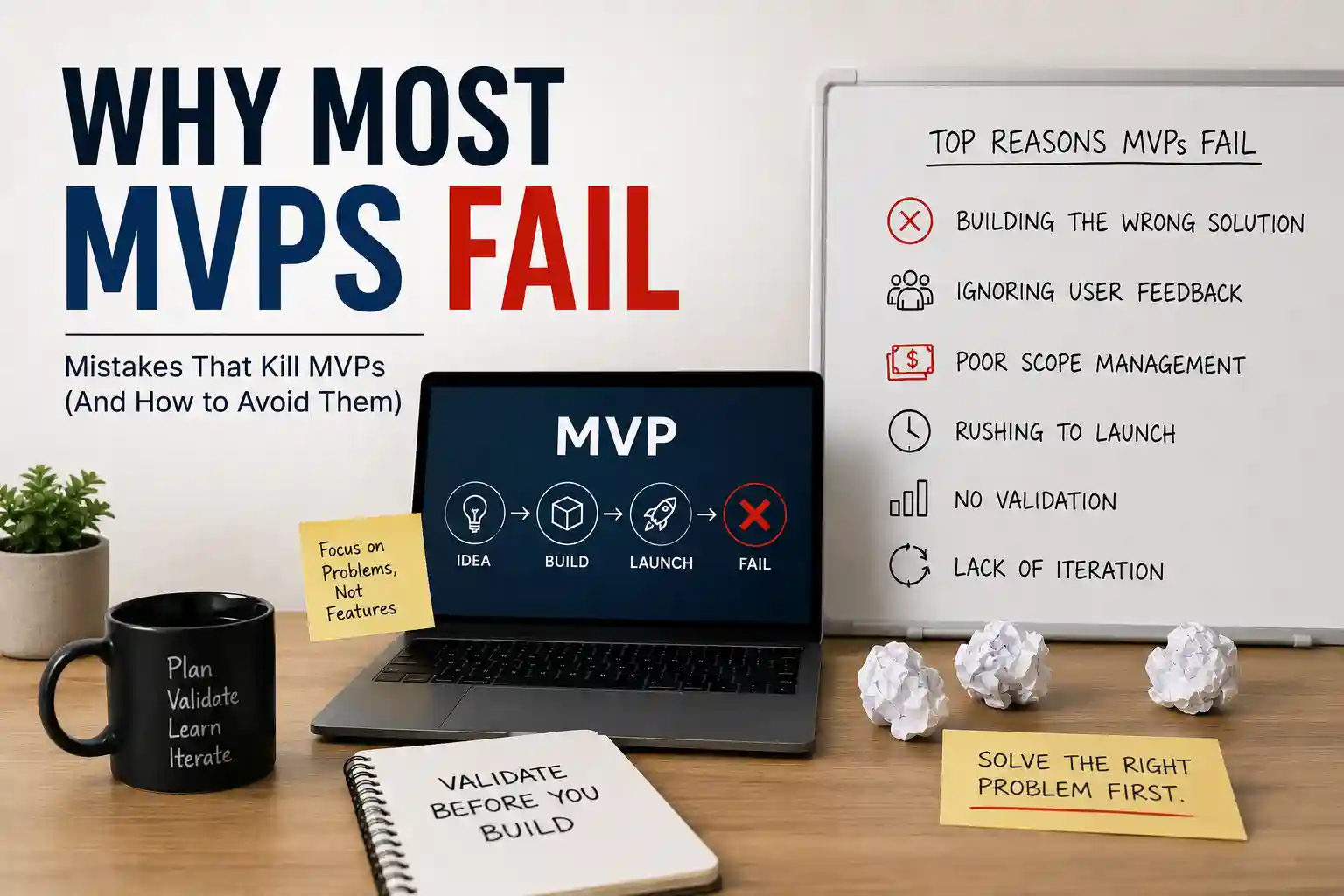
Why Most MVPs Fail in the First 6 Months (and How to De-Risk Yours) | Yantrix Labs
9 in 10 MVPs fail within 6 months of launch. Here are the real reasons — and a practical checklist to make sure yours is not one of them.
Author
Yantrix Labs
An MVP is supposed to be the fastest, cheapest way to learn what your users want. In practice, most MVPs are either not minimal enough, not viable enough, or not validated with real users before launch. The result is a product that took 6–12 months and $30,000–$100,000 to build — and generated no meaningful traction.
The 7 Reasons Most MVPs Fail
Reason 01
The scope was not actually minimal
Most founders build 30+ features because they are afraid a stripped-down version will not impress users. A focused product with 5–7 core features gets meaningful feedback faster and cheaper than a bloated one.
Reason 02
No real users were consulted before building
The most expensive mistake in product development is spending months building something based on what you think users want, then discovering after launch that they want something different.
Reason 03
The product launched with no acquisition channel
Many founders treat distribution as something to figure out after launch. The result: a working product with zero users 3 months after going live. A product nobody can find is not a viable product.
Reason 04
The tech was over-engineered for stage 1
Microservices, Kubernetes, and event-driven architecture are not what you need for a product with no users yet. Some agencies build enterprise-grade infrastructure for a 50-user MVP because it is what they are comfortable with.
Reason 05
The budget ran out before learning happened
Many founders spend their entire development budget getting to launch, with nothing left for iteration. Real learning happens after users have touched the product and you discover what they actually do vs. what you expected.
Reason 06
No success metric was defined before launch
Many founders cannot answer: "What result from this MVP would make you confident to invest more?" Without a clear success metric, every user behaviour is ambiguous.
Reason 07
The MVP took too long to build
An MVP that takes 12 months to build is not an MVP — it is a full product. The longer the build, the more scope creep occurs and the more time competitors have to enter the market.
MVP De-Risk Checklist
Building your MVP? Let's scope it properly first.
Yantrix Labs runs a free 1-hour discovery session before every engagement — we scope the feature set, identify risks, and give you a realistic timeline and cost estimate before you commit.
Book a free discovery session →Related Articles

Stay Updated
Get latest articles, tutorials and product insights delivered to your inbox.
No spam. Unsubscribe anytime.