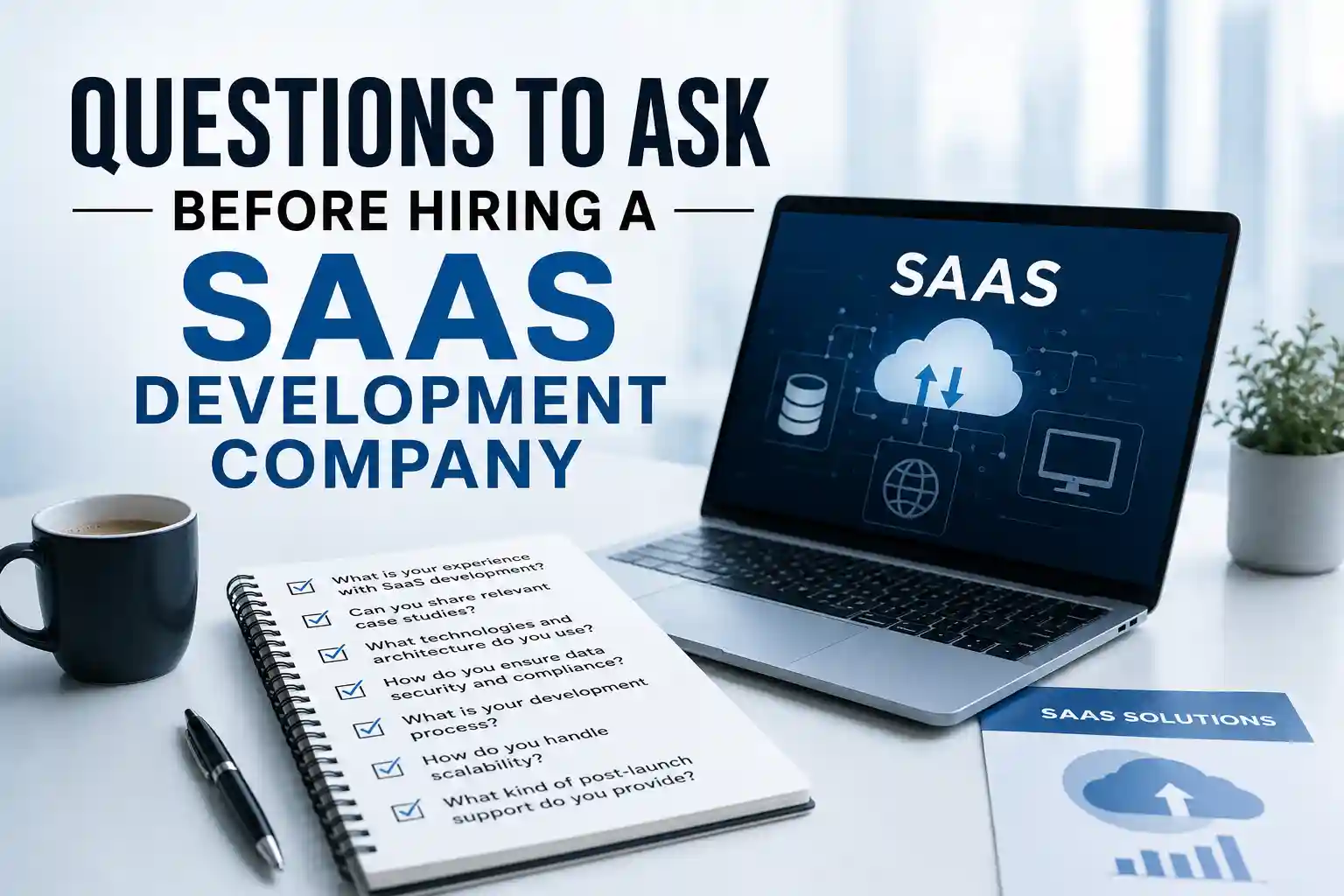
Top 10 Questions to Ask Before Hiring a SaaS Development Company | Yantrix Labs
Before signing any contract with a SaaS development company, ask these 10 questions. They reveal whether an agency can actually deliver your product — or just take your budget.
Author
Yantrix Labs
Choosing a SaaS development company is one of the most consequential decisions a non-technical founder makes. The wrong choice means months of delays, a codebase you cannot maintain, or a product that breaks at scale. These 10 questions separate strong agencies from the ones that look good in a sales call.
The 10 Questions
Can you show me live SaaS products you have built — not mockups?
Any agency can show a polished Figma mockup. What you need is a live URL, running in production, with real users — demonstrating the complexity level you need: multi-tenant user management, subscription billing, role-based access.
Who owns the code at the end, and when does ownership transfer?
Some agencies retain copyright until final payment. Others retain licensing rights to reusable components. This is one of the most important legal questions — and many clients never raise it.
What tech stack do you recommend for my product, and why?
A strong agency asks about your scale targets and long-term plans before recommending a stack. A weak agency defaults to whatever framework they know best, regardless of fit.
How do you handle changing requirements during the build?
Requirements always change. The question is whether the agency has a documented process — or handles it informally, which leads to scope creep that arrives as a budget surprise at the end.
Who will actually be working on my project day to day?
A common practice: agencies pitch with their best senior engineers, then switch to junior developers once signed. Ask to meet the team that will build your product — not just the sales lead.
How do you approach multi-tenant architecture for SaaS?
This is the single most technically important question for a SaaS product. Multi-tenancy can be implemented as separate databases per tenant, shared database with tenant-ID columns, or hybrid models. If the agency cannot explain their preferred approach and the reasoning, they have probably not built real SaaS products before.
What does post-launch support include, and for how long?
Most agencies include a short defect warranty (typically 30–90 days). Understanding this upfront prevents the situation where your product launches with bugs and the agency treats fixes as billable scope.
How do you handle security and data privacy in your builds?
Ask specifically: how they store passwords (bcrypt or argon2?), how they handle secrets and environment variables, whether they use parameterised queries to prevent SQL injection.
What does your QA process look like?
Many agencies treat QA as a box-tick at the end. This produces brittle code that fails in edge cases. Ask whether QA is a separate person from the developer and whether they write automated tests.
What documentation will you deliver at the end?
When the agency hands over the code, you need to understand what was built, how to run it, and how to extend it. Undocumented code is a liability.
Strong vs Weak Agency — At a Glance
Want to see how Yantrix Labs answers these questions?
We build SaaS products, web platforms, and mobile apps for founders across India and globally. Schedule a free consultation and we will walk you through our process.
Talk to our team →Related Articles
Stay Updated
Get latest articles, tutorials and product insights delivered to your inbox.
No spam. Unsubscribe anytime.